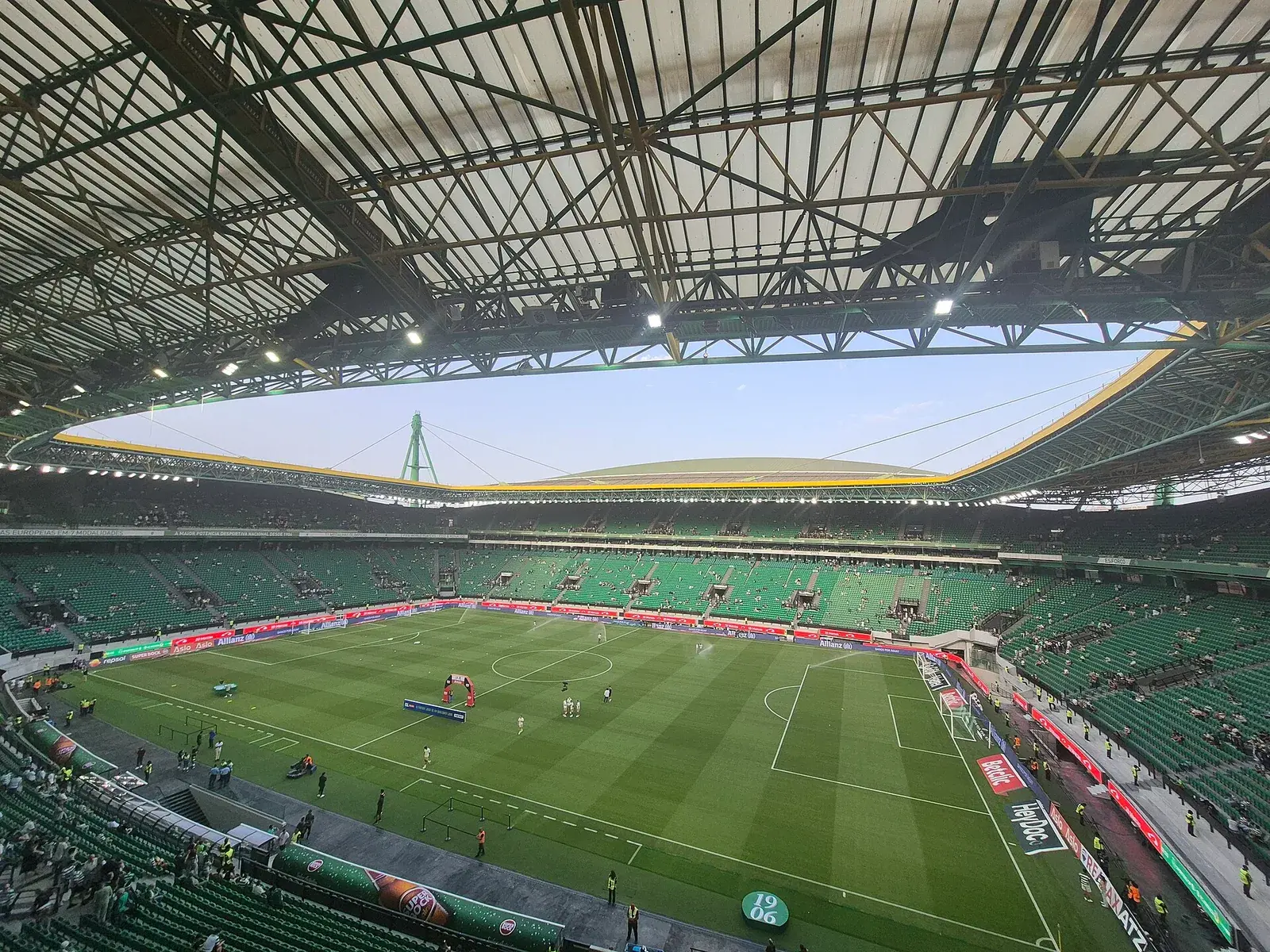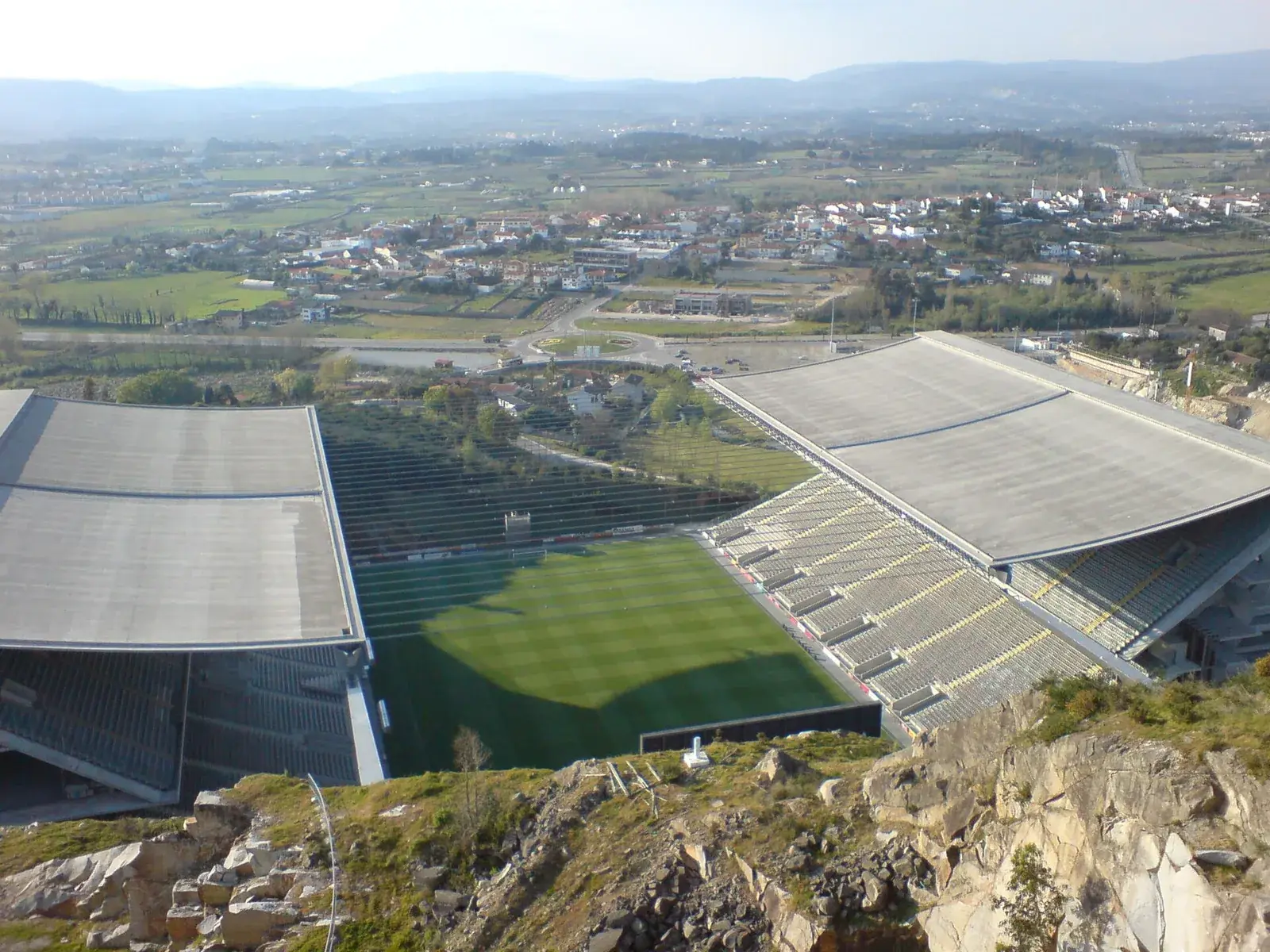
Estádio Municipal de Braga
Photo: Wikimedia Commons contributors · CC BY-SA
- Capacity
- 30,286
- Year opened
- 2003
- Club
- S.C. Braga
- Country
- Portugal
Overview
About the stadium
Estádio Municipal de Braga, known as A Pedreira ('the quarry'), is one of the most architecturally extraordinary football stadiums in the world. Built as a venue for UEFA Euro 2004 and opened in 2003, it was designed by Portuguese architect Eduardo Souto de Moura, who went on to receive the Pritzker Prize in 2011 — architecture's highest honour. The stadium holds 30,286 spectators and is home to SC Braga, nicknamed Os Arsenalistas.
Location and surroundings
The stadium sits on the southwestern edge of Braga, the principal city of the Minho region in northern Portugal. It is built directly into the face of the Monte Castro granite quarry — the source of its popular nickname A Pedreira. The north stand is carved into the rock massif, while the south stand faces it across the pitch. The two ends are left open, framing views of the surrounding forested hillside. The setting is unlike any other football ground in the world.
Main uses
The arena is the home of SC Braga for Primeira Liga matches and regular UEFA competition fixtures. The club is one of Portugal's 'Big Three' alongside Benfica and FC Porto in terms of European presence. Beyond football, the stadium is used for cultural and civic events by the municipality of Braga.
History
Journey through time
The story of Estádio Municipal de Braga is one of architectural courage: a city and a club willing to build something that had never been done before, in a setting that made the task far more complex than a conventional stadium construction.
Construction and opening
The stadium was completed and officially opened in 2003. The city of Braga commissioned Eduardo Souto de Moura, a Porto-born architect already celebrated for quiet, rigorous work in the tradition of Álvaro Siza Vieira. His design was radical: two parallel grandstands with no corner connections, roofs suspended by steel cables above each long side, and the quarry rock face itself serving as the 'third tribune'. The decision to leave both end zones fully open — framing views of the natural landscape — was controversial but became the building's defining gesture. Construction required extraordinary engineering work to stabilise the quarry face and integrate the structure into the granite substrate.
UEFA Euro 2004
Within months of its inauguration, the stadium hosted group-stage matches at UEFA Euro 2004, including a fixture between Spain and Greece. International media attention focused heavily on the architecture as much as the football, with images of the quarry-face stand circulating worldwide and establishing the stadium's global reputation almost immediately.
Architectural recognition
Eduardo Souto de Moura was awarded the Pritzker Prize in 2011, with the Braga stadium cited as one of the central works of his career. The building has since appeared in virtually every serious survey of outstanding sports architecture and has become a destination for architectural tourism independent of any scheduled match.
Atmosphere
Matchday
The atmosphere at A Pedreira is shaped by a setting that has no parallel in football: the granite quarry face behind the north stand reflects and amplifies crowd noise, creating an acoustic environment that supporters and visitors consistently describe as one of the most intense in European football.
Fan culture
SC Braga, Os Arsenalistas, command a passionate following across the Minho region. The club's regular presence in UEFA competition — including deep runs in the UEFA Europa League — has built a fanbase that expects and celebrates European nights. The most active supporter groups occupy the north stand, producing flag choreographies, continuous chanting, and occasional pyrotechnics throughout matches. The club's identity is closely tied to Braga itself, a mid-sized city with a strong sense of regional pride, and that pride is tangible at the stadium on big matchdays.
Big matches
The stadium's most dramatic moment came in the 2010/11 UEFA Europa League, when SC Braga reached the semi-finals — their deepest ever run in a major European competition — before losing to Benfica. The European knockout nights at A Pedreira, with both stands packed and the quarry wall as backdrop, rank consistently among the most memorable atmospheres in continental club football. UEFA Euro 2004 brought the stadium to the world's attention in its very first season, hosting fixtures that drew supporters from across Europe and cemented Braga's place on the map of elite European football.
Practical info
Visiting the stadium
Braga is a highly accessible and rewarding destination in northern Portugal, and a visit to A Pedreira combines naturally with the city's exceptional historical attractions — pilgrimage sites, Baroque stairways, and Roman ruins are all within easy reach.
How to get there
- Train: Braga has its own station on the Porto line; direct Intercidade and regional services make the journey from Porto in approximately 50 minutes. The stadium is reachable from the station by taxi or city bus
- Car: from Porto via motorway A3, approximately 50 km and 45 minutes; car parking is available at and around the stadium
- City bus: Braga's urban bus network connects the city centre with the stadium in around 10–15 minutes
- From Porto Airport: approximately 55 km by car, around 45 minutes
Tickets and tours
Match tickets for SC Braga are sold via the official club website. Domestic league fixtures and European home games sell out frequently; advance booking is strongly recommended. The stadium also offers architectural guided tours, which are exceptionally popular with visitors who come specifically for the building rather than a match. Tour booking in advance is advised.
Visitor tips
- When to arrive: at least 60 minutes before kick-off — even without a full house, arriving early to take in the quarry setting from inside the stands is worthwhile
- What not to miss: the view of the rock face from the north stand; the panoramic vista of the Minho hills through the open south end
- Braga city centre: the Bom Jesus do Monte pilgrimage stairway, the Roman archaeology of Bracara Augusta, and the historic Praça da República are all accessible by public transport from the stadium area
Clubs & teams
Map
Where to find the stadium
Rating
Your rating
No ratings yet
Plan your visit
Braga, Portugal
Accommodation
Booking.com — affiliate ID not configured
Stadium tour
GetYourGuide — partner ID not configured
Match tickets
Ticombo — affiliate ID not configured
Some links are affiliate — if you purchase, we earn a small commission (no extra cost to you).