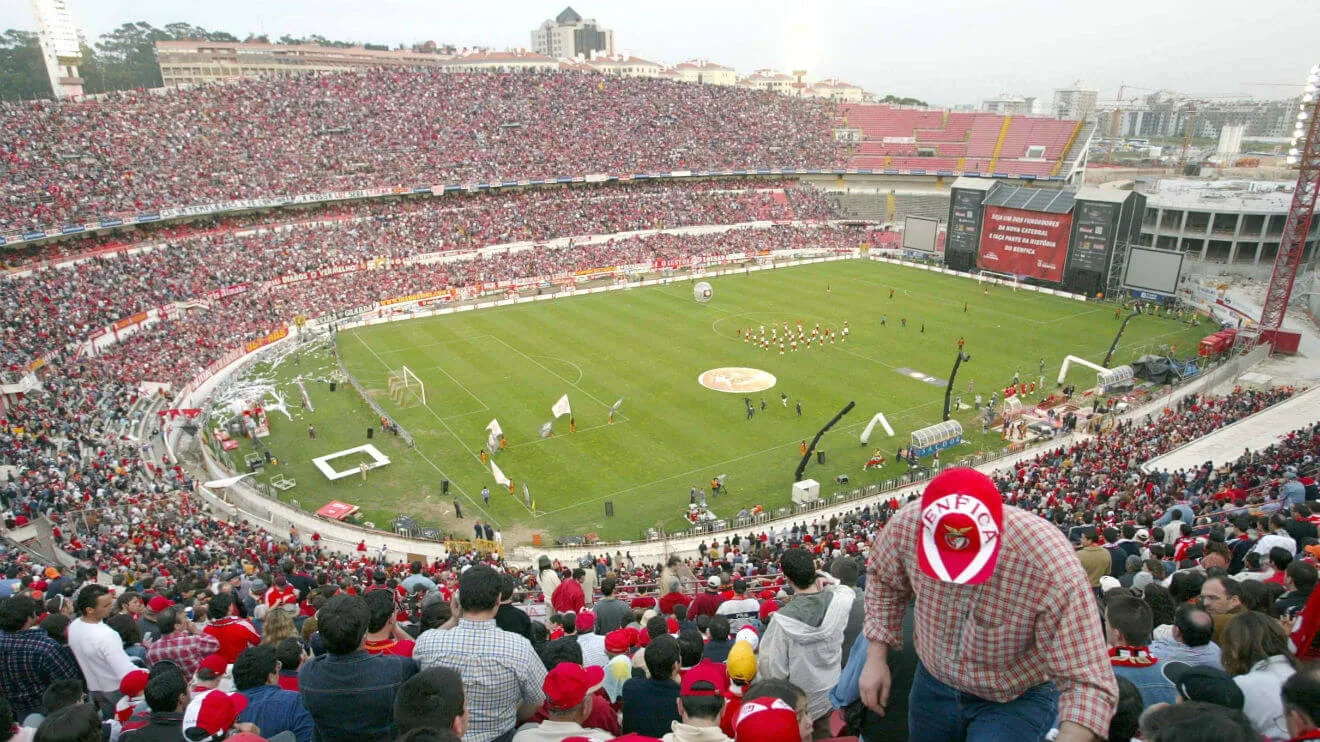
Estádio da Luz (1954)
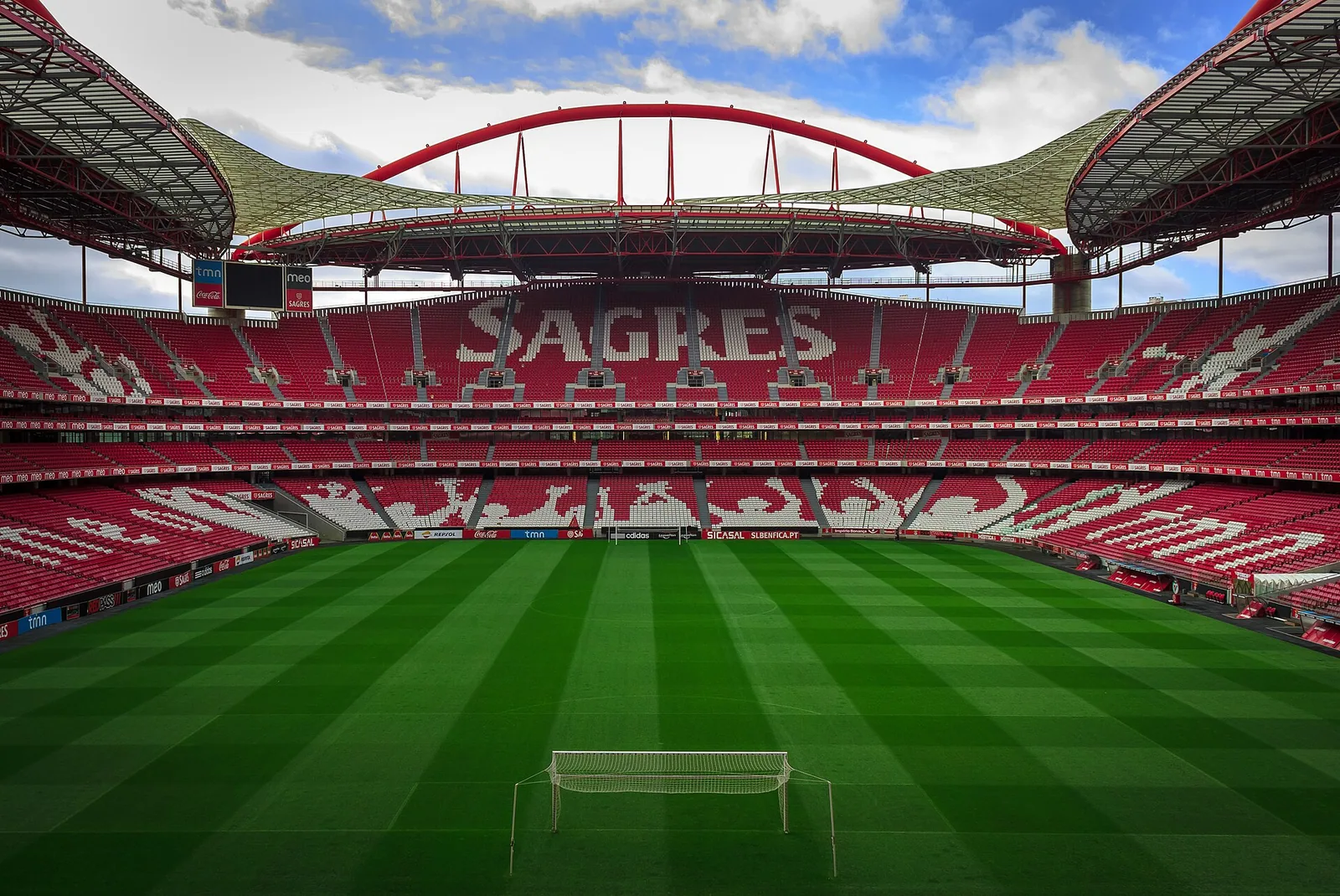
Foto: SL Benfica · © SL Benfica (oficiální materiál klubu) · zdroj
- Kapacita
- 120 000
- Postaven
- 1954
- Klub
- S.L. Benfica
- Země
- Portugal
Přehled
O stadionu
Estádio da Luz – literally 'Stadium of Light' – was a historic multi-purpose stadium in the Luz district of Lisbon, Portugal, that served as the home ground of Sport Lisboa e Benfica from its opening in 1954 until its demolition in 2003. At the peak of its use in the 1970s and 1980s it could hold over 120,000 spectators, ranking it among the largest football venues on the continent. The stadium no longer stands – a modern replacement opened in October 2003 on adjacent land – but the original Luz occupies a permanent place in European football mythology.
Location and character
The stadium stood in the north-western outskirts of Lisbon, in the Benfica-Luz neighbourhood approximately 8 km from the city centre. The monumental concrete bowl, open to the sky with steep standing terraces, embodied the tradition of the great populist European arenas of the mid-20th century. Its defining feature was the vast stepped terasso -- steep terracing capable of absorbing tens of thousands of standing supporters whose noise, funnelled by the bowl shape, reached seismic levels on big nights.
Historical legacy
The original Luz was constructed as Benfica entered its first golden era. It witnessed both European Cup triumphs (1961 and 1962) and dozens of domestic titles over nearly half a century. Demolished in 2003, it passed its name and spirit to its modern successor, which stands as a direct homage to the legend of the original.
Historie
Cesta časem
The story of the original Estádio da Luz is inseparable from the history of Benfica and the golden age of European club football.
Construction and opening (1954)
The stadium was inaugurated on 1 December 1954 as the largest football ground in Portugal at the time. Its construction was driven by the rapid growth of Benfica's fanbase in the post-war years and the inadequacy of the ageing Estádio do Campo Grande. Initial seated and standing capacity was estimated at 40,000–50,000, but in practice the open terraces allowed much larger crowds to be packed in, particularly for major fixtures.
Golden era of the 1960s and 1970s
The stadium's most celebrated chapter was the 1960s, when Benfica dominated European football. In 1960/61 and 1961/62 the club won the European Cup -- the continent's supreme club trophy -- on both occasions with Eusébio, the 'Black Panther', as the decisive force. The atmosphere on European nights reputedly shook the concrete structure as 80,000 to 90,000 supporters roared their heroes on. Portuguese league derbies against Sporting CP regularly attracted crowds exceeding 100,000.
Peak capacity and expansion
Through the 1970s the stadium underwent successive expansions, adding new terrace tiers and eventually reaching a theoretical capacity in excess of 120,000. A friendly against Nacional of Montevideo in 1978 was reportedly attended by approximately 128,000 spectators, confirming the original Luz as one of the largest venues in Europe alongside Camp Nou and the old Wembley.
Decline and demolition
From the 1990s the stadium progressively failed to meet modern UEFA safety standards. When Portugal was awarded the UEFA Euro 2004 tournament, a complete reconstruction on the existing site was deemed technically and logistically impossible. The decision was taken to build a new arena on the adjacent plot; the original Luz was progressively decommissioned and demolished in 2003, its name and identity inherited by the modern 64,642-seat replacement that opened the same year.
Atmosféra
Den zápasu
The atmosphere inside the original Estádio da Luz was widely regarded as among the most intimidating in European football. The steep concrete terracing that enclosed the bowl acted as a natural amplifier, multiplying crowd noise into a wall of sound that visiting teams found deeply unsettling.
Standing culture and supporter groups
The backbone of the matchday experience was the massive standing terasso, where Benfica supporters would pack shoulder to shoulder from the first whistle to the last. The singing, drumming and chanting culture that had developed at earlier Benfica grounds was perfected here across five decades. The Diabos Vermelhos (Red Devils) and other supporter factions maintained a continuous red-and-white display of flags, banners and rhythmic choruses. The collective roar of 'Glorioso!' -- the club's self-bestowed title -- became the sonic identity of the venue.
Iconic nights
The most celebrated atmospheric moments include the 1965 European Cup quarter-final against Real Madrid, where Eusébio's brilliance before approximately 90,000 roaring supporters produced one of the great individual European performances. Regular Portuguese league derbies in the 1970s and 1980s routinely surpassed 100,000 attendances -- figures unimaginable in modern European stadia. For visiting clubs from abroad, the original Luz had the reputation of an unconquerable fortress.
Praktické info
Návštěva stadionu
The original Estádio da Luz no longer exists -- it was demolished in 2003 and the land has largely been absorbed into the surrounding neighbourhood. This section is for visitors with a historical interest in the site.
Where the stadium stood
The original arena occupied ground now corresponding roughly to the car parks and open areas around Avenida Lusíada in the Luz district of Lisbon. The nearest metro station is Colégio Militar/Luz on the blue line (linha azul), from which the area is about 5 minutes on foot. The modern Estádio da Luz -- built directly beside the original -- occupies the adjacent plot and remains fully operational.
Museum and documentation
The history of the original stadium is comprehensively documented at the Museu Benfica -- Cosme Damião, located within the modern stadium complex. The museum holds photographs, trophies and artefacts from the 1950s to the 1990s, giving visitors a vivid sense of what the original Luz looked, sounded and felt like. The museum is open year-round and combined tickets include a tour of the modern arena.
Tips for historical visitors
- No commemorative plaques or markers remain on the site of the original stadium -- the demolition was total.
- Archival photographs and architectural drawings of the original arena are held at the Arquivo Municipal de Lisboa.
- The best way to understand the era of the original Luz is a visit to the Benfica museum inside the modern stadium.
- The modern Estádio da Luz offers guided tours on non-matchdays that include references to the original venue's history.
Video
Stadion v pohybu
Mapa
Kde najdeš stadion
Hodnocení
Tvoje hodnocení
Zatím bez hodnocení
Naplánuj návštěvu
Lisbon, Portugal
Ubytování
Booking.com — affiliate ID není nakonfigurováno
Stadium tour
GetYourGuide — partner ID není nakonfigurováno
Vstupenky
Ticombo — affiliate ID není nakonfigurováno
Některé odkazy jsou affiliate — pokud nakoupíš, dostaneme malou provizi (cena pro tebe se nemění).