White City Stadium
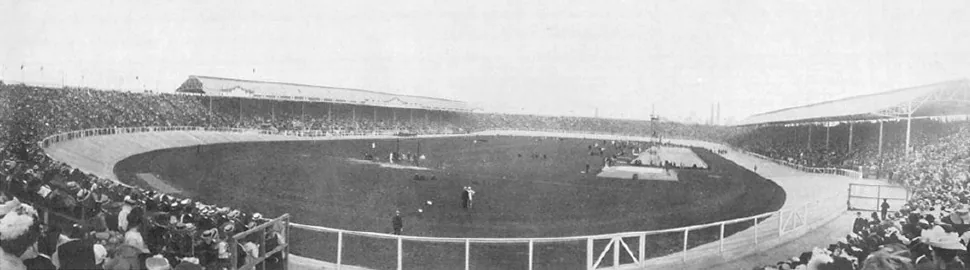
Foto: Unknown · Public domain · zdroj
- Kapacita
- 93 000
- Postaven
- —
- Klub
- —
- Země
- United Kingdom
Přehled
O stadionu
White City Stadium was a historic multi-purpose arena located in the Hammersmith and Fulham district of west London. At its peak it could accommodate approximately 93,000 spectators, making it one of the largest sporting venues in the British Isles. Built expressly for the 1908 Summer Olympics, the stadium served for nearly eight decades as a venue for athletics, greyhound racing, motorsport and football before being demolished in 1985. The site is now occupied by the BBC White City media campus.
Location and surroundings
The stadium stood in the White City area of west London, on a site adjacent to the Franco-British Exhibition of 1908, which gave the whole district its name -- a reference to the brilliant white facades of the exhibition pavilions. Today the immediate area is dominated by the BBC broadcasting complex and the Westfield London shopping centre, with no physical trace of the stadium remaining.
Main uses
Over its lifetime the stadium hosted the Olympic Games, the British Empire/Commonwealth Games, international athletics, greyhound racing (from 1927 until closure), speedway, boxing galas and one match during the 1966 FIFA World Cup. It was a true multi-purpose venue in the tradition of its era.
Historie
Cesta časem
White City Stadium is inseparably linked to the early history of the modern Olympic movement and to British sport in the first half of the twentieth century.
Construction for the 1908 Olympics
The stadium was constructed in the remarkable time of just ten months as the centrepiece of the 1908 Summer Olympics in London. The Games had originally been awarded to Rome, but following the eruption of Vesuvius in 1906 London stepped in as replacement host. The stadium was built by the showman and impresario Imre Kiralfy as part of the broader Franco-British Exhibition grounds and could hold approximately 93,000 spectators at opening -- a staggering capacity for the Edwardian era.
The marathon incident and Olympic legacy
At the 1908 Games the stadium became the backdrop for one of the most celebrated episodes in Olympic history: the chaotic finish of the marathon. Italian runner Dorando Pietri entered the stadium first but collapsed repeatedly from exhaustion; officials helped him to the finishing line, resulting in his disqualification. The victory was awarded to American John Hayes. The incident was captured in photographs and newsreel footage that circled the globe, making the marathon a popular event overnight. The stadium also hosted swimming in a specially constructed pool, cycling and numerous field events.
Inter-war years and the Empire Games
In 1927 White City Stadium became home to greyhound racing, which rapidly became a fixture of London working-class sporting life. Weekly meetings drew tens of thousands across social classes. In 1934 the stadium hosted the British Empire Games (later the Commonwealth Games), cementing its continuing importance on the international stage.
1966 World Cup and the final years
On 19 July 1966 White City hosted one Group 1 match of the 1966 FIFA World Cup -- France vs. Uruguay, which finished 0-0. The fixture had been moved from Wembley for scheduling reasons. In the following decades the stadium gradually deteriorated; renovation proposals came to nothing. The stadium was demolished in 1985 and the cleared site was transferred to the BBC and later to commercial development.
Atmosféra
Den zápasu
White City Stadium existed in a different age from today's single-sport arenas. It was a sprawling, multi-purpose civic ground rather than a purpose-built football cathedral, and its atmosphere carried a quality distinct from anything that exists today.
Olympic grandeur
From its very first event the stadium carried a sense of historic occasion. The crowd of nearly 100,000 that watched the dramatic marathon finish in 1908 experienced an emotional intensity that helped define public expectations of the Olympic Games. The sheer scale of the ground -- with its sweeping open terraces -- created a sound environment that eyewitnesses compared to standing inside a vast resonating shell.
Greyhound racing as social ritual
From 1927 onward the stadium became the spiritual home of London greyhound racing. Every week workers, city clerks and socialites rubbed shoulders on the terraces, united by the short, sharp drama of the dogs rounding the track. The proximity of the animals, the speed of the races and the communal tension of collective wagering gave White City a pulse unlike any football ground.
A venue that outlived its era
By the 1970s the stadium had begun to feel anachronistic -- too large, too expensive to maintain and too versatile to serve any single paying crowd. Many who had attended its great events only reflected on the loss once the wrecking ball fell in 1985. Contemporary accounts describe the demolition as the quiet end of an Edwardian sporting world.
Praktické info
Návštěva stadionu
White City Stadium was demolished in 1985 and no longer exists as a physical venue. Visitors interested in its history can explore the site where it once stood and trace its legacy through London's archives and museums.
Where the stadium stood
The original site lies in the White City area of west London, immediately accessible from White City underground station (Central line) and Wood Lane station (Circle/Hammersmith & City). Today the grounds are occupied by the BBC White City complex. No original structure survives.
Getting to the site
- Underground: White City (Central line) or Wood Lane (Circle / Hammersmith & City line).
- Bus: Multiple routes serve the Shepherd's Bush and White City interchange.
- On foot: The area is an approximately 10-minute walk from Shepherd's Bush Market station.
Where the legacy lives on
- The Museum of London and the Victoria and Albert Museum hold artefacts and photographic records from the 1908 Games.
- The British Olympic Association archive contains detailed documentation of the stadium's Olympic role.
- A heritage information board near the BBC White City campus acknowledges the history of the site.
Tips for history enthusiasts
- The surrounding White City estate, built in the 1930s-1960s, reflects the neighbourhood's post-exhibition social history.
- The marathon route from Windsor Castle to White City Stadium -- 26 miles 385 yards -- became the standardised marathon distance adopted worldwide, a direct legacy of the 1908 Games held here.
Video
Stadion v pohybu
Mapa
Kde najdeš stadion
Hodnocení
Tvoje hodnocení
1 hodnocení
Naplánuj návštěvu
Hammersmith, United Kingdom
Ubytování
Booking.com — affiliate ID není nakonfigurováno
Stadium tour
GetYourGuide — partner ID není nakonfigurováno
Vstupenky
Ticombo — affiliate ID není nakonfigurováno
Některé odkazy jsou affiliate — pokud nakoupíš, dostaneme malou provizi (cena pro tebe se nemění).