Ullevi
Photo: Wikimedia contributors · CC BY-SA 3.0
- Capacity
- 43,000
- Year opened
- 1958
- Club
- IFK Göteborg
- Country
- Sweden
Overview
About the stadium
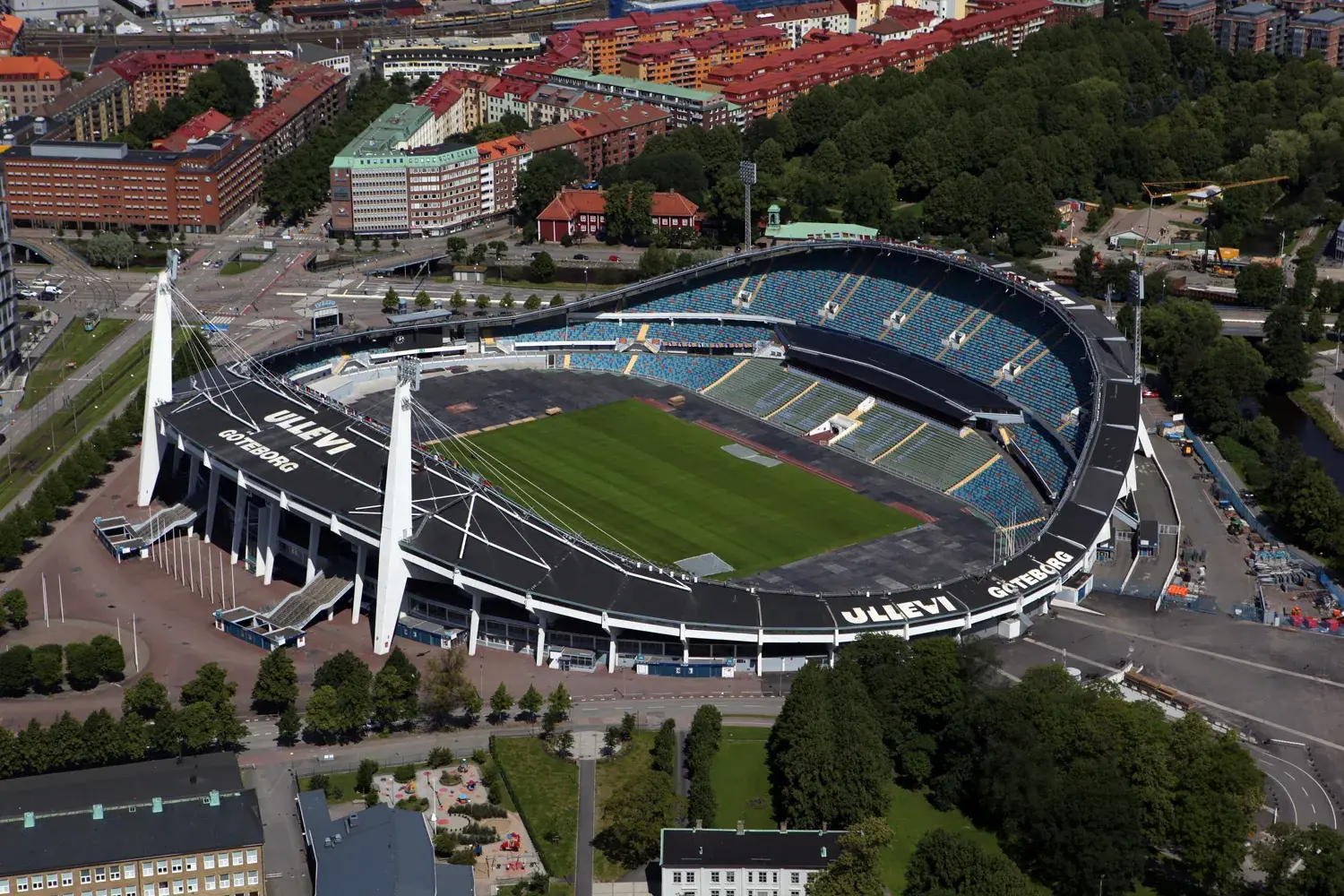
Ullevi, officially Nya Ullevi (New Ullevi), is a multi-purpose stadium in Gothenburg, Sweden's second-largest city. With a capacity of approximately 43,000 seats it is the second-largest stadium in Scandinavia. The stadium was designed by architect Fritz Jaenecke and built specifically for the 1958 FIFA World Cup. It is operated by the city-owned company Got Event.
Location and surroundings
Ullevi sits in central Gothenburg near the Heden district, within easy walking distance of the historic city centre and well served by tram lines. Immediately adjacent stands Gamla Ullevi — a smaller, modern football stadium opened in 2009 that is frequently confused with Ullevi. They are two entirely separate venues.
Main uses
Ullevi hosts Swedish national football team matches, major club fixtures for IFK Göteborg, and large-scale concerts. The stadium has staged the 1995 World Championships in Athletics, the 2006 European Athletics Championships, the UEFA Cup Winners' Cup finals of 1983 and 1990, the UEFA Euro 1992 final, and the 2004 UEFA Cup final. It also hosts the opening ceremony of the Gothia Cup every year.
History
Journey through time
Ullevi's construction is inseparable from Sweden's hosting of the 1958 FIFA World Cup, which became one of the most celebrated tournaments in the competition's history — won by a 17-year-old Pelé for Brazil.
Construction and opening
The stadium was designed by Gothenburg architect Fritz Jaenecke and completed in time for the 1958 FIFA World Cup. Original capacity exceeded 50,000. The structure features a characteristic open oval with large concrete stands, typical of 1950s stadium design. It hosted several group-stage matches and the third-place play-off during the tournament.
Key post-1958 milestones
Ullevi quickly became Sweden's most prominent sporting venue outside Stockholm. It hosted UEFA Cup Winners' Cup finals in 1983 and 1990 — in both cases as one leg of the then two-legged final format. The defining moment came in 1992 when the UEFA European Championship final was staged here: Denmark, who had entered as a late replacement for Yugoslavia, defeated Germany 2-0 in one of the biggest upsets in tournament football. The 1995 World Championships in Athletics and the 2004 UEFA Cup final further cemented the stadium's European standing.
Renovations
Several phased renovations improved safety and spectator comfort over the decades. Some standing areas were converted to seating, reducing total capacity from the original figure. Despite updates, Ullevi has retained much of its 1950s character and silhouette.
Atmosphere
Matchday
Ullevi carries the weight of Gothenburg's football identity — a city that produced one of Sweden's most successful club sides and regularly punches above its weight on the European stage. Matchdays here carry a distinct sense of occasion.
Fan culture
IFK Goteborg is the most decorated Swedish club in European competition, winning the UEFA Cup twice (1982 and 1987). In the 1987 two-legged final against Dundee United, IFK played their 'home' leg at Ullevi. Supporters are passionate, vocal, and fiercely proud of the club's history; the end stands fill with blue-and-white colours and coordinated chanting during big matches. National team fixtures bring a broader, celebratory atmosphere as supporters from across western Sweden converge on the city.
Big matches and concerts
The UEFA Euro 1992 final remains the stadium's most celebrated football moment: Denmark's shock victory over Germany wrote football history, and Ullevi was the stage. The 1995 World Athletics Championships brought a different crowd but the same electric capacity atmosphere. As a concert venue, Ullevi has hosted Rolling Stones, Bruce Springsteen, U2, and numerous other global acts — the open bowl amplifies sound remarkably well, making large outdoor shows here a memorable experience.
Practical info
Visiting the stadium
Gothenburg is well connected by air and rail, and Ullevi's central location makes it one of Europe's easier major stadiums to reach without a car.
How to get there
- Tram (spårvagn): Multiple lines serve the Heden/Korsvägen area; roughly 10 minutes from Gothenburg Centralstation
- On foot: Approximately 15-20 minutes' walk from the city centre
- Car: Central Gothenburg has paid parking zones; public transport is strongly recommended on event days
- Train: Gothenburg Centralstation is approximately 1.5 hours from Stockholm and 3 hours from Copenhagen
Tickets and tours
Swedish national team match tickets are sold via Svenska Fotbollförbundet (SvFF). IFK Göteborg match tickets are available through the club website or at the ground. Concert tickets are handled by Got Event or Ticketmaster. Regular stadium tours are not permanently available; check the Got Event website for current offerings.
Visitor tips
- Watch for confusion: Gamla Ullevi is a smaller, entirely separate stadium immediately next door — confirm which venue your event is at before travelling
- Weather: Gothenburg summers are mild but rain is common; bring a waterproof layer
- When to arrive: At least 45 minutes before kick-off; the surrounding streets fill quickly for large events
Clubs & teams
Map
Where to find the stadium
Rating
Your rating
No ratings yet
Plan your visit
Göteborg, Sweden
Accommodation
Booking.com — affiliate ID not configured
Stadium tour
GetYourGuide — partner ID not configured
Match tickets
Ticombo — affiliate ID not configured
Some links are affiliate — if you purchase, we earn a small commission (no extra cost to you).