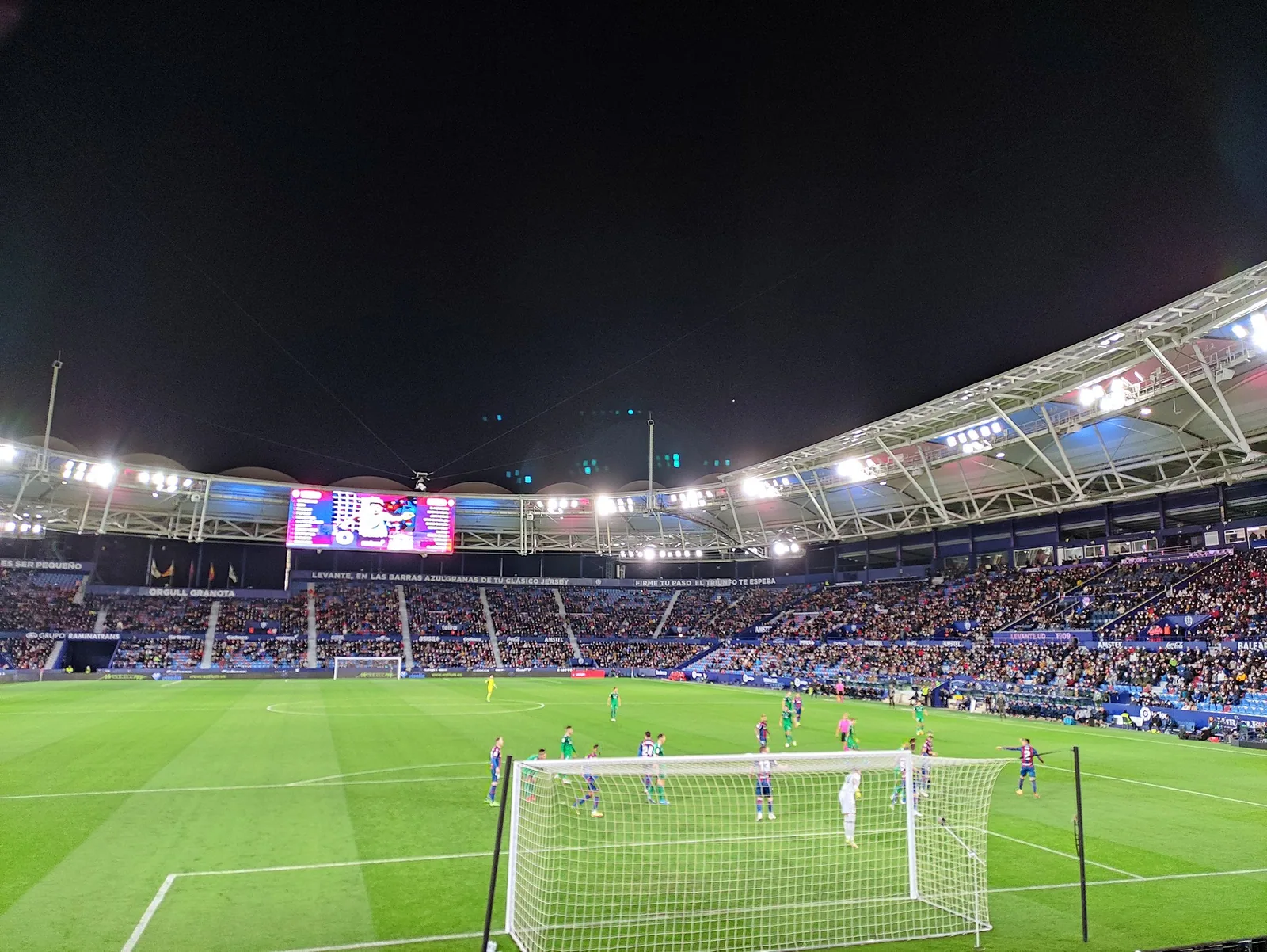
Estadi Ciutat de València
Foto: Francesc Fort · CC BY-SA 4.0 · zdroj
- Kapacita
- 26 354
- Postaven
- 1969
- Klub
- Levante UD
- Země
- Spain
Přehled
O stadionu
Estadi Ciutat de València is a football stadium in Valencia and the home ground of Levante UD. With a capacity of 26,354 seats, it is the 23rd-largest stadium in Spain and the fourth-largest in the Valencian Community. Opened in 1969, the stadium is historically tied to an alternative Valencian footballing identity — Levante UD represents the working-class northern districts of the city, providing a sharp contrast to the more globally prominent Valencia CF.
Location and surroundings
The stadium is located in the Orriols district in northern Valencia, approximately 4 kilometres from the historic city centre. The surrounding area is a dense urban neighbourhood with a traditional Valencian character; a metro line runs nearby, linking the stadium to the centre and other parts of the city. The district has a distinctly working-class feel and strong identification with the club.
Main uses
The arena serves exclusively as the home ground of Levante UD in La Liga or the Segunda Division, and occasionally hosts matches of the women's side Levante UD B (Women). It is also the setting for the Derbi de la Comunitat — the fiercely contested regional derby between Levante UD and rivals Valencia CF.
Historie
Cesta časem
Levante UD is one of the oldest football clubs in Spain, founded in 1909. The club endured decades of highs and lows before the stadium now known as Estadi Ciutat de València was opened in 1969 under the name Estadio Antonio Román, honouring the then-president of the club.
From Estadio Antonio Román to the current name
The ground carried the name Estadio Antonio Román for several decades. Over the years it underwent a series of gradual modernisations and capacity adjustments to keep pace with the demands of competitive football. The Valencian (Catalan) name Estadi Ciutat de València — Stadium of the City of Valencia — was adopted as an expression of the club's regional identity; estadi is the Valencian equivalent of the Spanish estadio.
Returns to La Liga
The most celebrated chapter of modern Levante UD history is the club's repeated returns to the top flight. Levante earned promotion to La Liga in 2010 and held their place in the first division for several consecutive seasons. In 2011/12, Levante stunned Spanish football by finishing in the upper half of the La Liga table and qualifying for the preliminary rounds of the UEFA Europa League — the finest result in the club's modern era. Estadi Ciutat de València saw genuine European-level football during those seasons.
Symbol of Valencian duality
Valencia is a city divided by football: Valencia CF represents a traditionally prestigious club with international renown, while Levante UD embodies the pride of the city's northern and working-class neighbourhoods. Estadi Ciutat de València is more than just a stadium — it is a symbol of a community that values its own identity independently of its powerful neighbour.
Atmosféra
Den zápasu
The atmosphere at Estadi Ciutat de València is notable for its intensity relative to the stadium's modest size. Levante UD fans — granotes (frogs, a nickname derived from the club's red-and-blue colours) — are known for vocal, passionate support with a strongly communal, neighbourhood character.
Fan culture
Support for Levante UD is deeply rooted in the working-class districts of Valencia. For many supporters, the club is a matter of identity and a statement of independence from the dominant Valencia CF. This underdog spirit permeates the entire fan culture and gives matchdays at Estadi Ciutat de València a special charge. Fans arrive with drums, chants and flags in red and blue; the Fondo Norte terrace is traditionally the loudest section of the ground.
Derbi de la Comunitat
The most electrifying occasions at Estadi Ciutat de València arrive with the Derbi de la Comunitat — the clash between Levante UD and Valencia CF. It is one of the most intensely charged local derbies in Spanish football: two Valencian clubs with entirely different fan bases and contrasting identities. For Levante supporters, every victory over the stronger rival is a cause for legendary celebration. Tickets for these fixtures sell out within minutes of going on sale.
Praktické info
Návštěva stadionu
Estadi Ciutat de València is situated in the Orriols district in northern Valencia and can be reached by metro or bus from the city centre.
How to get there
- Metro: The most convenient option — the Orriols station on line 1 is right next to the stadium; the journey from the centre takes roughly 10-15 minutes
- Bus (EMT Valencia): Several urban bus lines stop near the stadium; services are reinforced on matchdays
- Car: Street parking is available in the surrounding area; arriving at least 60 minutes before kick-off is advisable
- Walking from the centre: Approximately 45-55 minutes on foot; a viable option in good weather
Tickets and tours
Levante UD sell match tickets through the official club website and stadium box offices. For regular league fixtures, tickets are generally available without difficulty; for the Derbi de la Comunitat buying well in advance is essential — demand is very high and tickets sell rapidly. The club occasionally offers behind-the-scenes stadium tours.
Visitor tips
- When to arrive: At least 45-60 minutes before kick-off; bars in the neighbourhood fill up with supporters early
- Derby tickets: For matches against Valencia CF, watch closely for when tickets go on sale and act immediately
- Local gastronomy: Valencia is the birthplace of paella — enjoy a meal before the match in the restaurants around Orriols or in the nearby city centre
Kluby a týmy
Mapa
Kde najdeš stadion
Hodnocení
Tvoje hodnocení
Zatím bez hodnocení
Naplánuj návštěvu
Valencia, Spain
Ubytování
Booking.com — affiliate ID není nakonfigurováno
Stadium tour
GetYourGuide — partner ID není nakonfigurováno
Vstupenky
Ticombo — affiliate ID není nakonfigurováno
Některé odkazy jsou affiliate — pokud nakoupíš, dostaneme malou provizi (cena pro tebe se nemění).