Borussia-Park
Foto: Arne Müseler · CC BY-SA 3.0 de · zdroj
- Kapacita
- 59 749
- Postaven
- 2004
- Země
- Germany
Přehled
O stadionu
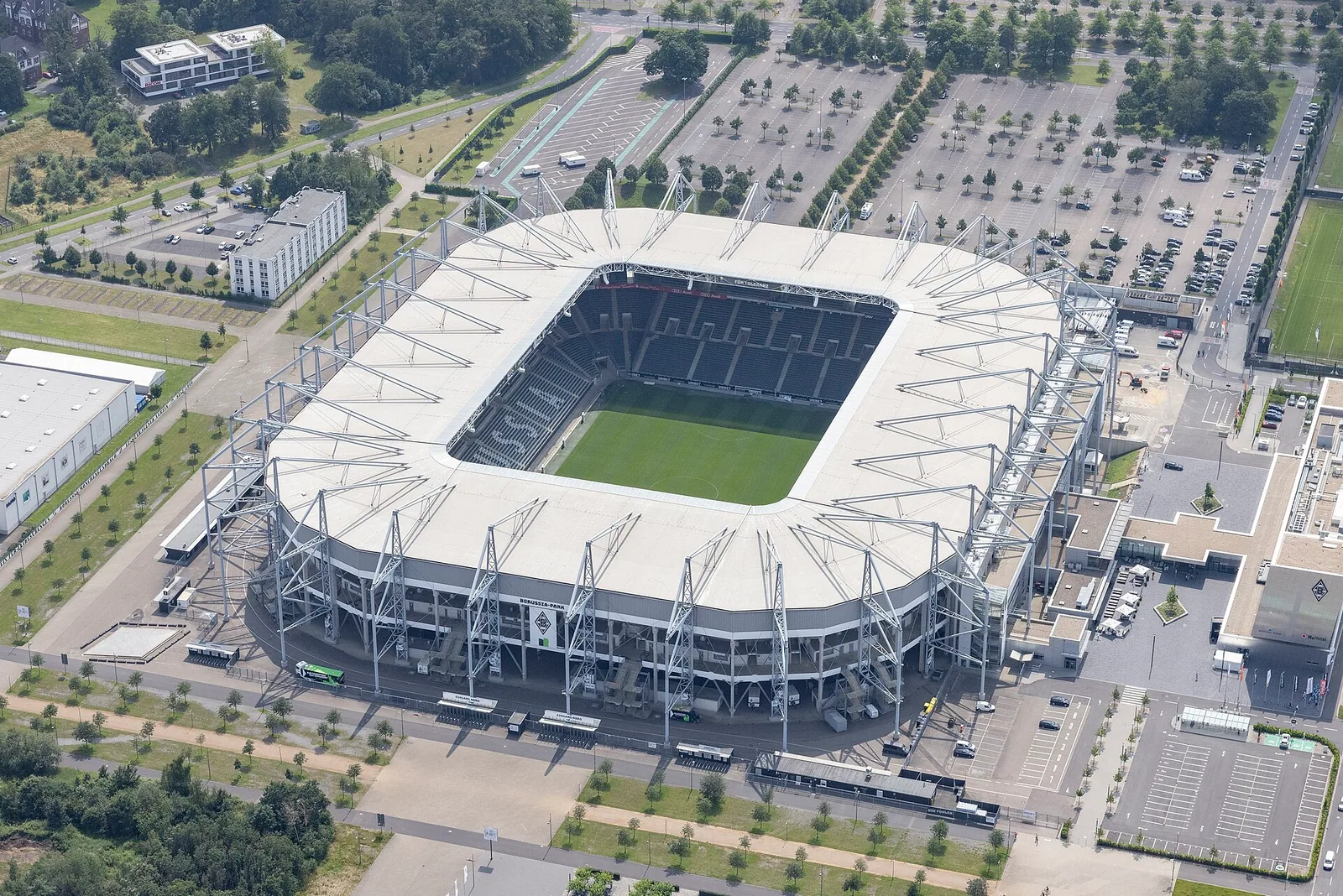
Borussia-Park is a modern football stadium in Mönchengladbach, North Rhine-Westphalia, Germany. Opened in 2004, it holds 54,057 spectators in total — 16,145 standing and the remainder seated. For international fixtures the capacity is reduced to 46,249. The stadium serves as the home ground of Bundesliga club Borussia Mönchengladbach.
Location and surroundings
The stadium is located on the outskirts of Mönchengladbach in a predominantly flat, semi-industrial area that offers easy access by both car and public transport. Its prominent position on the city's edge makes it visible from a distance, and ample parking is available in the surrounding zones.
Main uses
Borussia-Park is dedicated primarily to football as the home of Borussia Mönchengladbach in the Bundesliga and European competitions. The complex includes VIP lounges, a fan shop, and a sports bar, providing comprehensive facilities for supporters and corporate guests alike. Outside the football season the venue occasionally hosts other sports and commercial events.
Historie
Cesta časem
Borussia-Park was built to replace the historic Bokelberg Stadium, which had served the club for decades but no longer met modern football requirements by the turn of the millennium.
Construction and opening
The stadium opened in 2004, delivering a purpose-built modern arena with a capacity exceeding 54,000. The project gave the club state-of-the-art media facilities, expanded VIP infrastructure, and a large standing terrace holding over 16,000 passionate supporters. The stadium is operated directly by Borussia Mönchengladbach.
Major renovations
Since its opening in 2004 the stadium has not undergone major structural reconstruction. Technical systems, lighting, and supporter facilities have been progressively modernised to keep pace with Bundesliga and UEFA competition requirements.
Notable moments
Borussia-Park has witnessed numerous memorable occasions as Borussia Mönchengladbach competed at the top of German football and in the UEFA Champions League. The stadium has hosted high-stakes Bundesliga clashes and European knockout ties that remain vivid in the memories of the club's supporters. Intense local derbies against rivals from the wider North Rhine-Westphalia region have been among the most electric occasions the venue has seen.
Atmosféra
Den zápasu
Borussia-Park generates one of the most intense matchday atmospheres in the Bundesliga, driven by a fiercely loyal fanbase and a massive standing terrace that keeps the noise level high throughout every match.
Fan culture
Borussia Mönchengladbach commands deep support across the city and the wider Rhineland region. The standing terrace, accommodating over 16,000 supporters, is the engine room of the stadium's atmosphere — coordinated chants, flags, and tifo displays from the ultras groups produce a wall of sound from kick-off to the final whistle. Supporters take immense pride in the club's celebrated era in the 1970s and 1980s, when Borussia dominated German football and competed at the highest European level, winning the UEFA Cup twice. That heritage is passed down to younger generations and remains a central part of matchday identity. Derby fixtures and European nights push the atmosphere to its peak, with a roar that carries far beyond the stadium's walls.
Big matches
Borussia-Park's standout occasions include UEFA Champions League group stage and knockout matches that drew European rivals to Mönchengladbach and filled the stadium to capacity. Bundesliga derbies against clubs from across North Rhine-Westphalia consistently produce some of the season's most charged atmospheres. When the stakes are highest, the combination of the large standing terrace, a compact stadium bowl, and a committed fanbase makes Borussia-Park one of the more formidable venues in German football.
Praktické info
Návštěva stadionu
Visiting Borussia-Park is manageable with some advance planning. The most convenient transport option depends on your starting point, but public transport and road access are both reasonable.
How to get there
- Train: Mönchengladbach Hauptbahnhof is the closest major rail hub; local buses and taxis connect to the stadium
- Bus: Local bus services from Mönchengladbach city centre run to the stadium and are typically reinforced on matchdays
- Car: The stadium is accessible via motorway A61 (exit Mönchengladbach-Rheydt) and other approach roads; car parks are available nearby
Tickets and tours
Match tickets for Borussia Mönchengladbach are sold through the club's official website and stadium box offices. High-demand fixtures sell out in advance, so early booking is recommended. The club offers stadium tours covering the dressing rooms, players' tunnel, and stand access — schedules and prices are listed on the official website.
Visitor tips
- When to arrive: At least 60 minutes before kick-off to avoid queues at turnstiles and concession stands
- Fan shop: Located within the stadium complex, open on matchdays and outside the season
- Sports bar: On-site option for pre-match and post-match refreshments in the stadium precinct
- Standing terrace: The best choice for an authentic, high-energy atmosphere — expect continuous chanting throughout
Kluby a týmy

Mapa
Kde najdeš stadion
Hodnocení
Tvoje hodnocení
Zatím bez hodnocení
Naplánuj návštěvu
Mönchengladbach, Germany
Ubytování
Booking.com — affiliate ID není nakonfigurováno
Stadium tour
GetYourGuide — partner ID není nakonfigurováno
Vstupenky
Ticombo — affiliate ID není nakonfigurováno
Některé odkazy jsou affiliate — pokud nakoupíš, dostaneme malou provizi (cena pro tebe se nemění).