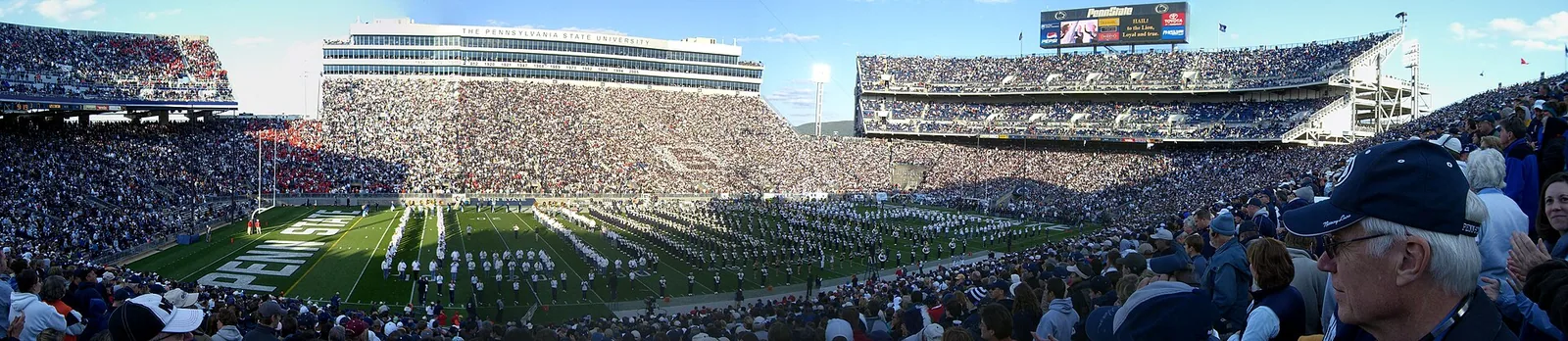
Beaver Stadium
Foto: Sbvr6 (talk) · CC BY-SA 3.0 · zdroj
- Kapacita
- 106 572
- Postaven
- 1960
- Klub
- —
- Země
- United States
Přehled
O stadionu
Beaver Stadium (official commercial name West Shore Home Field at Beaver Stadium) is an American football stadium on the campus of Penn State University in the town of State College, Pennsylvania. With a capacity of 106,572 spectators, it is the second largest stadium in the USA and holds the record for college arenas in the northern half of the country.
Home of the Penn State Nittany Lions
The arena has served since 1960 as the home ground for the Penn State Nittany Lions team in the NCAA Division I FBS, Big Ten Conference. Penn State is one of the traditional powers in American college football — it holds 2 national titles (1982, 1986) and a remarkable 50-year unbeaten streak from 1939 to 1988 under legendary coach Joe Paterno (1966–2011, with a record of 409 victories).
Named After a Governor
The stadium is named after James A. Beaver (1837–1914), governor of Pennsylvania and university president. Beaver was a patron of the campus expansion and the stadium has borne his name since the original Beaver Field in 1893.
Commercial Renaming (2024)
In August 2024, the university signed a contract with Pennsylvania construction company West Shore Home for $20 million USD annually for naming rights. The official name was thus changed to West Shore Home Field at Beaver Stadium, but fans and media continue to refer to it as the traditional Beaver Stadium.
Historie
Cesta časem
Beaver Field (1893–1959)
The first Beaver Field was built in 1893 on the older part of the Penn State campus and accommodated 500 spectators. In 1909, it was expanded to 3,500 seats, and by 1936 it reached a capacity of 30,000 spectators — by then it was at a second location, New Beaver Field, which is now the site of Pollock Halls.
Relocation and Construction (1959–1960)
In 1959, the university decided to relocate the stadium to a new site in the southern part of the campus. The demolished steel structure from New Beaver Field was transported and rebuilt on the new parcel. The grand opening took place on September 17, 1960, with a game against Boston University (Penn State won 20-0). Capacity: 46,284 seats.
Gradual Expansions Under Coach Paterno
Coach Joe Paterno (1966–2011) led the program to national prominence, which increased the demand for capacity:
- 1969 — addition of upper bleachers, capacity 57,538.
- 1972 — expanded to 60,203.
- 1976 — capacity 76,639.
- 1980 — 83,770.
- 1991 — 93,967.
- 1991 — installation of the first Jumbotron type scoreboard.
- 2001 — complete renovation for $93 million USD: an extension of the upper ring with luxury suite boxes and club seats, increasing capacity to 107,282.
- 2014 — installation of a 60 x 35-foot HD video board, one of the largest in college sports.
- 2024–2027 — a Capital Improvement Plan renovation is underway for $700 million USD: modernization of stands, new locker rooms, expansion of premium sections, and a full overhaul of all systems.
"White Out" Tradition (2004–Present)
In 2004, the Penn State marketing team introduced the "White Out" tradition — fans are encouraged to come fully dressed in white for a select key game of the season. The atmosphere during a White Out has repeatedly been described as the loudest in sports — measurements from 2014 recorded 108 dB at peak moments during the game, the equivalent of a landing airplane. ESPN calls Beaver Stadium the "loudest college stadium in America".
Atmosféra
Den zápasu
"We Are... Penn State" — The Spirit of the University
Penn State is one of the most traditional institutions in American college sports. The Nittany Lions, named after the Mount Nittany rock face near the campus, play in blue and white colors. Before each game, the legendary call-and-response takes place between the speaker and the fans:
- "We are..." (speaker)
- "Penn State!" (107,000 fans)
- — repeated three times.
This tradition dates back to 1948 and has become an inseparable part of campus culture and the entire state of Pennsylvania.
"White Out" — An Icon of College Sports
The highlight of the season is the "White Out" game, which draws 107,000 fans dressed in white. The atmosphere is deafening: a measurement from 2014 recorded 108 dB at the moment of a critical touchdown. ESPN, Sports Illustrated, and The New York Times repeatedly label the White Out as the most intense fan experience in American sports. The White Out typically takes place in October or early November against a major rival.
Major Rivalries
- Penn State vs. Ohio State — a modern Big Ten rivalry, played annually, often during White Out games.
- Penn State vs. Michigan — a historic rivalry, key for standings in the Big Ten.
- Penn State vs. Pittsburgh — a Pennsylvania rivalry, played intermittently.
Famous Moments
- September 17, 1960 — Grand opening, Penn State won 20-0 against Boston University.
- 1986 — Penn State won the national title defeating the Miami Hurricanes in the Fiesta Bowl 14-10, the most-watched college game in television history up to that point.
- November 3, 2007 — White Out against Ohio State, Penn State 17-10, marking the beginning of the modern White Out era.
- October 22, 2016 — White Out against Ohio State, Penn State 24-21, a blocked field goal by Marcus Allen in the final minute, one of the most dramatic wins of coach James Franklin's era.
- September 24, 2022 — Penn State White Out vs. Auburn, atmosphere labeled by ESPN as the loudest college game of the decade.
Nittany Lion Mascot Tradition
The Nittany Lion has been Penn State's official mascot since 1907. The current form, with a plush head and blue jersey, emerged in the 1950s and has become a symbol of the university. At key moments during the game, the Lion entertains fans with push-ups to the rhythm of the score — after each touchdown, it does as many push-ups as points Penn State is leading by.
Praktické info
Návštěva stadionu
Getting to the Stadium
The stadium is located at University Park Campus, State College, PA 16802, on the edge of the town of State College in central Pennsylvania. State College is a relatively isolated town, a 4-hour drive from Philadelphia, Pittsburgh, and New York City.
- Car: Take Interstate I-99 from the north, US-322 from the east, US-220 from the south. Paid parking is available around the stadium (zones 1–10), and for key games, spots sell out months in advance; "Tailgate parking" is permitted in designated areas.
- Airport: University Park Airport (SCE) is 5 km from the campus, a small regional airport with flights to Chicago, Detroit, Philadelphia, and Washington, D.C. Harrisburg International Airport (MDT) is 145 km away, Pittsburgh International (PIT) is 220 km away.
- Bus: Greyhound and Megabus provide daily routes from State College to Pittsburgh and Philadelphia (approximately 4 hours).
Tickets and Tours
- Tickets are sold through the official platform GoPSUSports.com, secondary markets StubHub and SeatGeek. Season ticket subscriptions hold more than 80% of holders for over 10 years, availability for new subscribers is limited.
- "White Out" game — tickets sell out during the first weekend of sales, on the secondary market starting from $400 USD.
- Stadium tours called the "Beaver Stadium Tour" take place on non-game days from April to November, lasting 90 minutes, reservations can be made through the university website.
- "All-Sports Museum" — the Penn State sports museum located inside the stadium showcases national titles, jerseys of legends (Joe Paterno, Franco Harris, Mike Reid), and interactive exhibits.
Visitor Tips
- Tailgate culture: Parking lots come alive 5–7 hours before the game; the "Penn State Tailgate" tradition involves grilling, parading, and typical metal beer barrels. Beginners are recommended to visit the "East Lots" for an open atmosphere.
- Weather: The season runs from September to November, November games may have temperatures around 0 °C, layered clothing, hats, and blankets are recommended.
- Nearby: The State College downtown area (College Avenue) has a variety of pubs and restaurants, visitors can also explore the Penn State Arboretum and the Mount Nittany Trail (a two-hour hike to the summit with views of the stadium).
- Accommodation: The Penn Stater Hotel directly on campus sells out months in advance; alternatives include Bellefonte (15 km) or Lewisburg (40 km).
Video
Stadion v pohybu
Mapa
Kde najdeš stadion
Hodnocení
Tvoje hodnocení
Zatím bez hodnocení
Naplánuj návštěvu
College Township, United States
Ubytování
Booking.com — affiliate ID není nakonfigurováno
Stadium tour
GetYourGuide — partner ID není nakonfigurováno
Vstupenky
Ticombo — affiliate ID není nakonfigurováno
Některé odkazy jsou affiliate — pokud nakoupíš, dostaneme malou provizi (cena pro tebe se nemění).